"There have been plenty of greater revolutions in the history of the modern world, and certainly plenty of more successful ones. Yet there has been none which spread more rapidly and widely, running like a brushfire across frontiers, countries and even oceans. In France, the natural centre and detonator of European revolutions, the Republic was proclaimed on 24 February. By 2 March revolution had gained south-west Germany, by 6 March Bavaria, by II March Berlin, by 13 March Vienna and almost immediately Hungary, by 18 March Milan and therefore Italy (where an independent revolt was already in possession of Sicily). At this time the most rapid information service available to anyone (that of the Rothschild bank) could not carry the news from Paris to Vienna in less than five days. Within a matter of weeks no government was left standing in an area of Europe which is today occupied by all or part of ten states, not counting lesser repercussions in a number of others. Moreover, 1848...
(Eric Hobsbawn - The Age of Capital 1848 - 1875)
France was boiling pot of Europe, every idea, movement, book even speech from France had been affecting Europe. And the next wave in 1848 would really shake all of Europe, in the end almost all of feudal regimes in Europe would collapse. And everything started in 22 February 1848 in Paris.
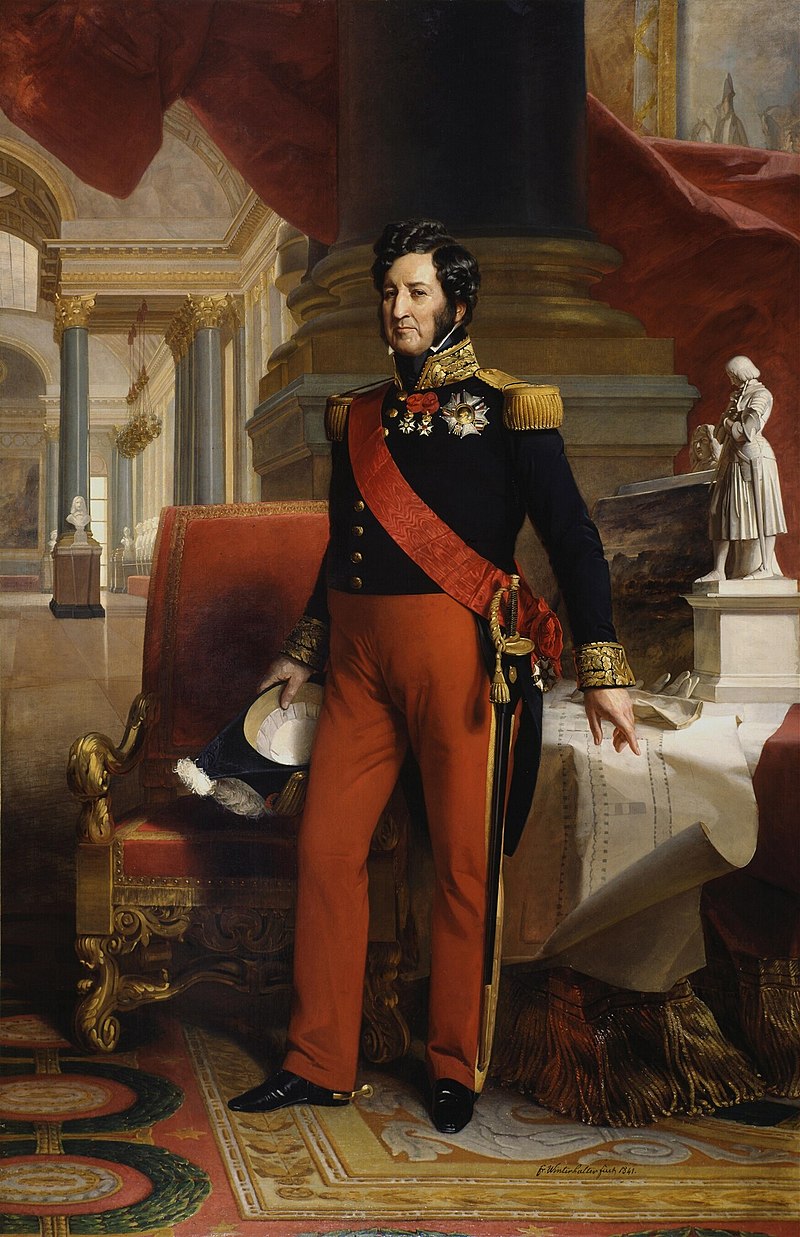
Unemployed workers and some seven hundred students gathered to protest the corrupt misrule of the constitutional monarchy led by Louise Phillpe. In 1789 monarchy was altered by bourgeois, in 1848 this time both monarchy and bourgeois were sitting on the throne together. Parliament was under their control
Belligrents:
Revolutionists: Unemployed workers, women and children/ some seven hundred students/ twelfth legion
Conservatives: 31.000 regular troops, 3.900 municipals and 85.000 national guards from Paris and the suburbs.
22 February 1848
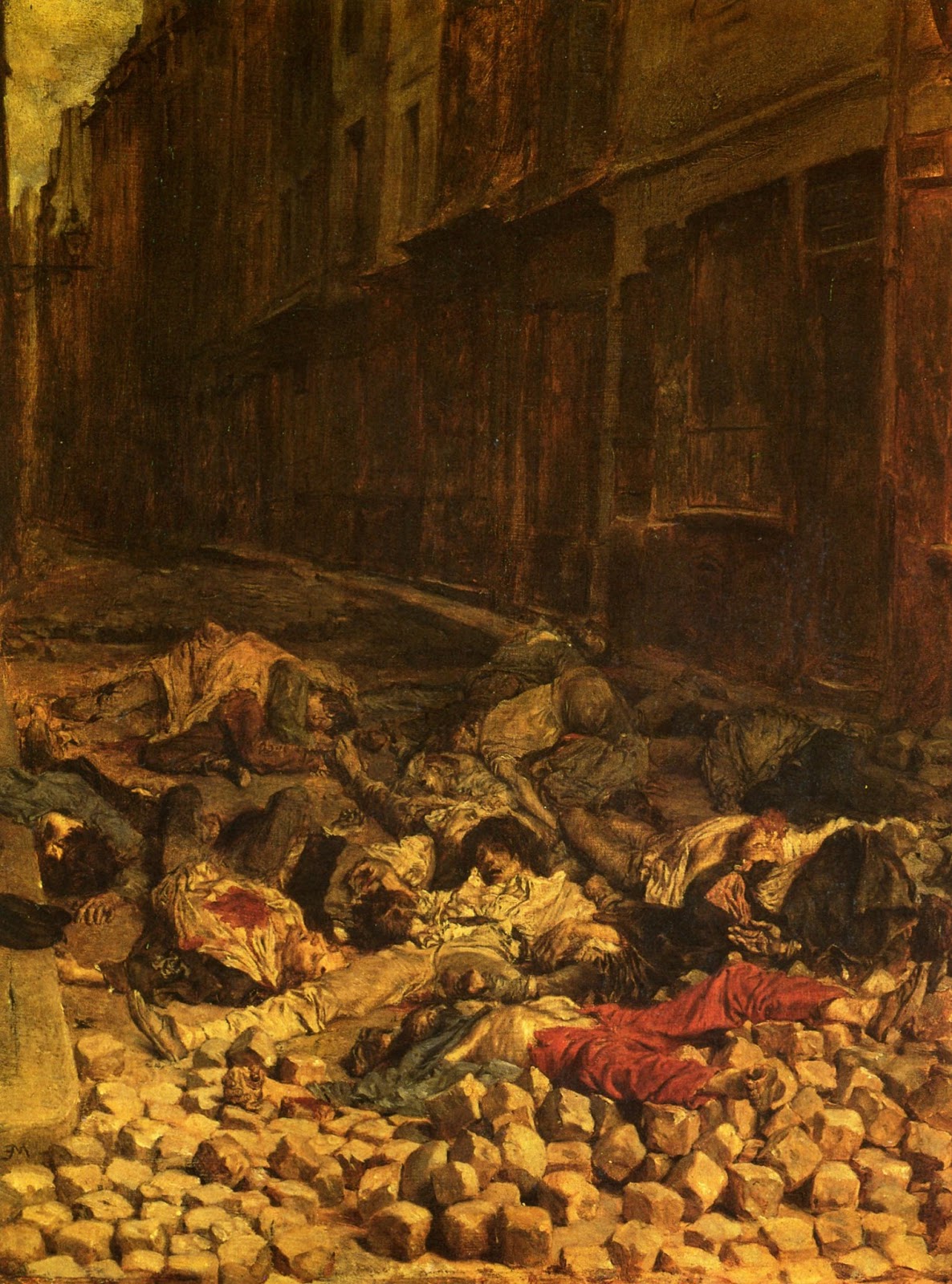
Revolutionists gathered in the Place de la Madeleine to claim their rights to work and began marching to the Place de la Concorde. They were building barricades in almost every streets and the population of crowds was raising in every hour. (Streets have never built such a narrow again.)Then the first blood was shed, old woman, who died when her head hit the paving stones; elsewhere a worker was hacked down by a sabre.
23 February 1848
Louis Philippe dismissed the prime minister Guizot who worked to sustain a constitutional monarchy following the July Revolution of 1830 however this did not decelerate the anger of people. There were 50 people killed by regular troops at the end of the day. People were shouting "revenge" while dead bodies were carrying. ‘At that moment,' noted d'Agoult, ‘the corpse of a woman had more power than the bravest army in the world.'
24 February 1848
Troops were trying to remove barricades without showing any violence, but this hesitation led revolutionist believe the cause and make them brave. Some national guards changed their sides and began to fight next to revolutionists. As a result army gave up the removal of barricades and went back to royal palace to defend it.
General Alphonse Bedeau: it ‘looked like a rout. The ranks were broken, the soldiers marched in disorder, heads down, exuding both shame and fear; as soon as one of them briefly fell out with the mass, he was quickly surrounded, seized, embraced, disarmed and sent on his way; all that was done within the blink of an eye.'
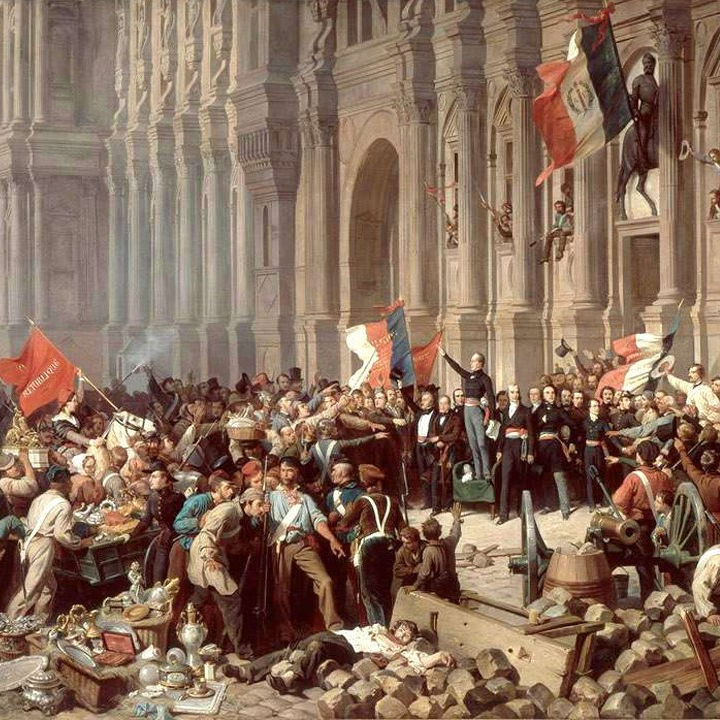
To the east the Hôtel de Ville, the seat of the city government, was taken by National Guards who had joined the revolutionaries. To the west Tocqueville, caught on the Place de la Concorde by a crowd of insurgents, escaped being beaten up or worse by a timely shout of ‘Vive la Réforme! You know that Guizot has fallen? Thiers urged the King to withdraw from the city, bring up regular troops and smash the revolution with overwhelming force from outside. It was a strategy Thiers would adopt much later against the Paris Commune in 1871.
Louis-Philippe, dressed (as he liked to do) in plain, bourgeois clothes, walked briskly with his wife Marie-Amélie through the Tuileries Gardens and boarded a carriage waiting on the Place de la Con corde, from where, escorted by loyal cavalrymen, they drove off, reaching Honfleur on 26 February.
The revolutionaries burst triumphantly into the now almost deserted palace. In another scene described by Flaubert, the crowd ‘surged up the stairs, a dizzying flood of bare heads, helmets, red bonnets, bayonets and shoulders'. Workers took turns to sit on the throne (the first, Flaubert writes, ‘beaming like an ape'). On the royal seat was written: ‘The People of Paris to All Europe: Liberty, Equality, Fraternity. 24 February 1848'. Then the proceedings took a more sinister turn, as the crowd smashed up furniture, china and mirrors.
25 February 1848
The throne was taken to the Place de la Bastille, where it was ceremonially burned In the early hours of 25 February, Lamartine dramatically strode out on to a balcony, declaring: ‘The Republic has been proclaimed!' His words unleashed a roar of ecstatic cheering.
The revolutions of 1848 ... require detailed study by state, people and region, for which this is not the place. Nevertheless they had a great deal in common, not least the fact that they occurred almost simultaneously, that their fates were intertwined, and that they all possessed a common mood and style, a curious romantic–utopian atmosphere and a similar rhetoric, for which the French have invented the word quarante-huitard . Every historian recognizes it immediately: the beards, flowing cravats and broad-brimmed hats of the militants, the tricolours, the ubiquitous barricades, the initial sense of liberation, of immense hope and optimistic confusion. It was ‘the springtime of the peoples' – and like spring, it did not last. We must now briefly look at their common characteristics...
In the first place they all succeeded and failed rapidly, and in most cases totally...
There had been one and only one major irreversible change: the abolition of serfdom in the Habsburg Empire. v Except for this single, though admittedly important, achievement, 1848 appears as the one revolution in the modern history of Europe which combines the greatest promise, the widest scope, and the most immediate initial success, with the most unqualified and rapid failure...
Now those who made the revolution were unquestionably the labouring poor. It was they who died on the urban barricades:...It was their hunger which powered the demonstrations that turned into revolutions...
There had been one and only one major irreversible change: the abolition of serfdom in the Habsburg Empire. Except for this single, though admittedly important, achievement, 1848 appears as the one revolution in the modern history of Europe which combines the greatest promise, the widest scope, and the most immediate initial success, with the most unqualified and rapid failure."
(Eric Hobsbawn - The Age of Capital 1848 - 1875)