People who travelled to Europe should be careful that they are standing right on the dream of 20th century's one of the best novelist who killed himself when he felt hopeless about Europe's future.
Most of people look and judge Europe with its daily life or historical places and say “These are same as our country, there is nothing different in Europe”. May be they are right at first look, same streets, buildings, cars etc. however when you read Stefan Zweig's novels and biograpies you see a dream of Europe which is lying on the basement of Europe still.
In Stefan Zweig's novels and stories, you could hate Calvin because of his dictatorial approach to Castello and free speech, or you could afraid of Luther while he is forcing Erasmus to select his own side instead of Vatican. And you could easily understand Erasmus, one of the first dreamers of Europe, while he were trying to fix something (Catholicism) in stead of destroy it. On the other hand, you could be inspired by mankinds' efforts on science when you read the race for South pole.
Science, free speech, negotiation, art, enjoyment, secularism and intellect these are pillars of Zweig's dream and you could easily find most of them in Europe now.
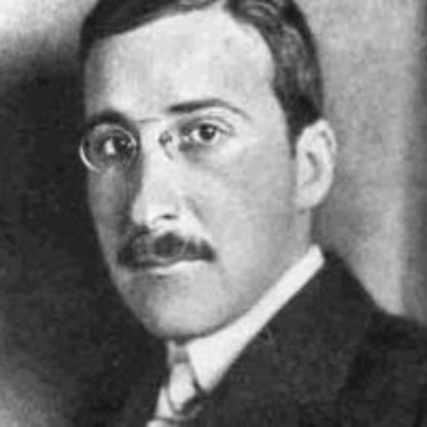
Stefan Zweig was born in Vienna (1881), his father Moritz Zweig was wealthy Jewish textile manufacturer and his mother Ida Brettauer was a daughter of Jewish Banking familiy. He was son of aristocratic family.He studied philosophy at the University of Vienna in 1904. Since his family was a high class Jewish family, he had a lot of useful relations. One of them was Theodor Herzl who was founder of World Zionist Organization and on of the fathers of modern politic Zionism. Herzl accepted for publication some of Zweig's early essays in Neue FreiePresse.
At the beginning of World War I, patriotic sentiment was widespread, and extended to many German and Austrian Jews: Zweig, as well as Martin Buber and Hermann Cohen, all showed support. Zweig served in the Archives of the Ministry of War and adopted a pacifist stand like his friend Romain Rolland, recipient of the Nobel Prize in Literature 1915.
Zweig career had reached its top point in 1920's and 1930's. He was extremely popular in the United States, South America and Europe, and remains so in continental Europe; however, he was largely ignored by the British public. Although he had been in England for 5 years, application to commemorate him with a blue plague on his home has been rejected by English Heritage in 2012.
He was good novelist and especially strong biography writer. He wrote several Euroepean hero's lifes like Erasmus, Magellan, Balzac, Marie-Antoinette, Nietsche etc.
He left his biggest love Europe with the rise of Hitler. He was Jew and antinationalist both of two were dangeraous in Austria and Germany during Hitler times. First he travelled to England and he had lived there for 5 years. Then in 1940, he and his second wife Lotte Altmann crossed the ocean towards to USA. They had not stayed there too much and went to a town which was a German-colo nized mountain town 68 kilometers north of Rio de Janeiro.
Feeling more and more depressed by the growth of intolerance, authoritarianism, and Nazism, and feeling hopeless for the future for humanity, Zweig wrote a note about his feelings of desperation. Then, in February 23, 1942, the Zweigs were found dead of a barbiturate overdose in their house in the city of Petrópolis, holding hands. He had been despairing at the future of Europe and its culture. "I think it better to conclude in good time and in erect bearing a life in which intellectual labour meant the purest joy and personal freedom the highest good on Earth," he wrote.