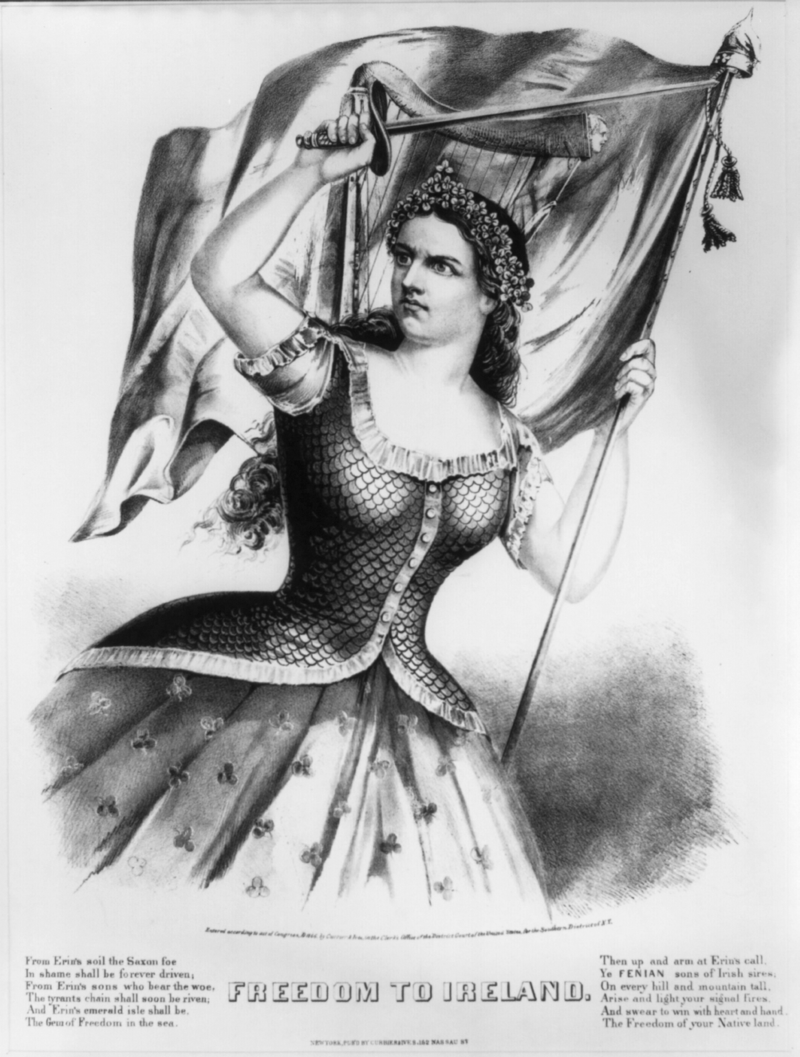
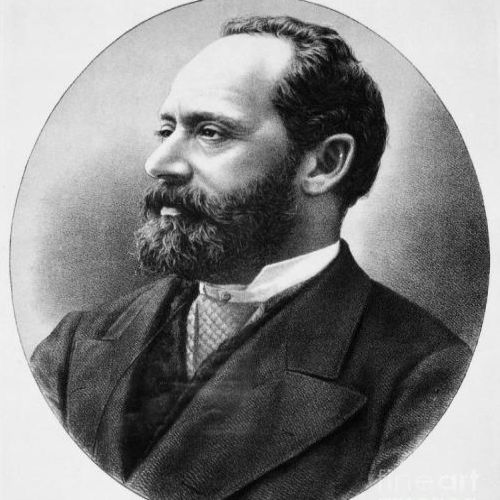
The core Irish component of the Fenians was the Irish Republican Brotherhood, which was founded in Paris in 1858 by James Stephens and John O'Mahoney, veterans of the Young Ireland movement of the 1840s. (The name originated with the Fianna in Irish mythology - groups of legendary warrior-bands associated with Fionn mac Cumhail.)
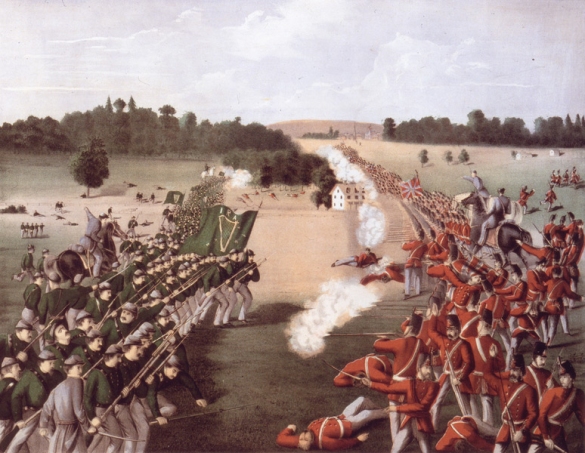
The society was founded in the United States by John O'Mahony and in Ireland by James Stephens (1858). Plans for a rising against British rule in Ireland miscarried, but the American Fenians staged abortive raids across the border into British Canada in 1866, 1870, and 1871 and were a cause of friction between the U.S. and British governments.
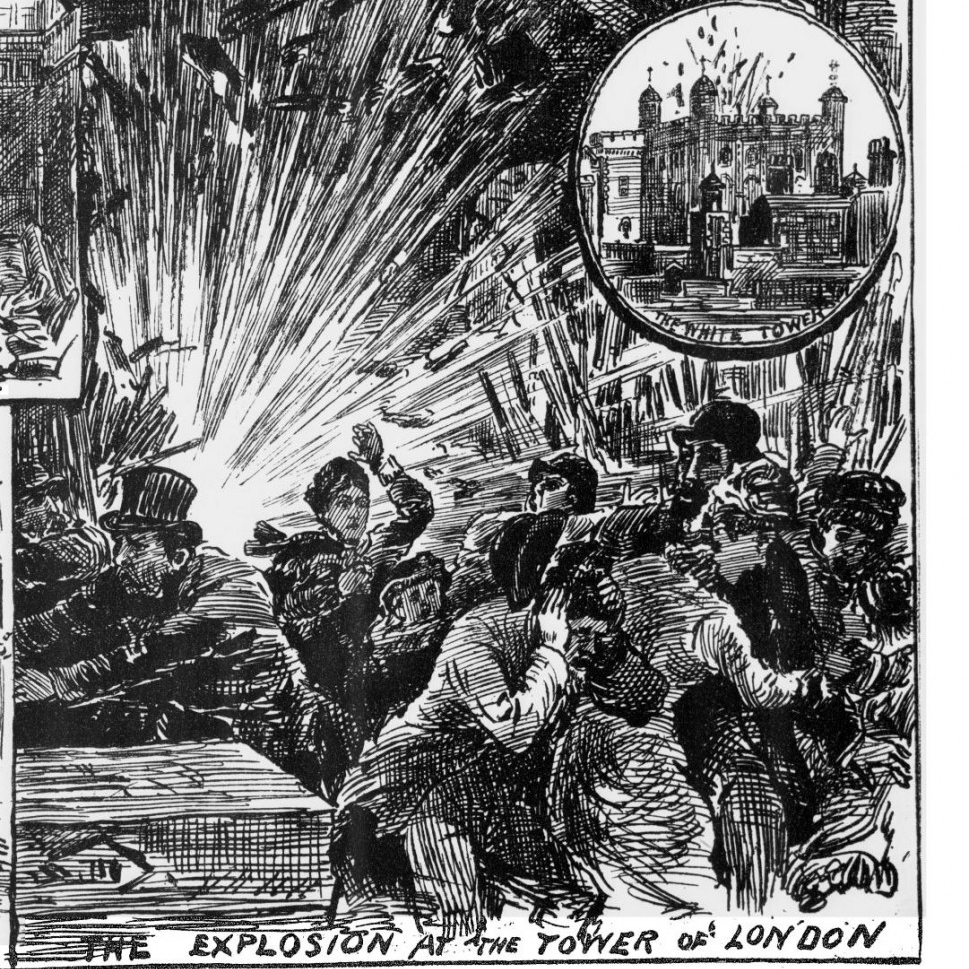
"The Irish Republican Brotherhood (‘Fenians'), with its still surviving Irish Republican Army, was the lineal descendant of the secret revolutionary fraternities of the pre-1848 period, and the longest-lived organization of its kind. Mass rural support for nationalist politicians was not in itself new, for the Irish combination of foreign conquest, poverty, oppression and a largely Anglo-Protestant landlord class imposed on an Irish-Catholic peasantry mobilized the least political. In the first half of the century the leaders of these mass movements had belonged to the (small) Irish middle class and their aim – supported by the only effective national organization, the church – had been a moderate accommodation with the English. The novelty of the Fenians, who first appeared as such in the late 1850s, was that they were entirely independent of the middle-class moderates, that they were the first to put forward a programme of total independence from England, to be achieved by armed insurrection. In spite of their name, derived from the heroic mythology of ancient Ireland, their ideology was quite non-traditional, though its secular, even anticlerical nationalism cannot conceal that for the mass of the Fenian Irish the criterion of nationality was (and still is) the Catholic faith. Their wholehearted concentration on an Irish Republic won by armed struggle replaced a social and economic, even a domestic political programme, and their heroic legend of rebel gunmen and martyrs has up to the present been too strong for those who wanted to formulate one. This is the ‘Republican tradition' which survives into the 1970s and has re-emerged in the Ulster civil war, in the ‘Provisional' IRA . The readiness of the Fenians to ally themselves with socialist revolutionaries, and of these to recognize the revolutionary character of Fenianism, should not encourage illusions about this. vi But neither should we underestimate the novelty, and the historic significance, of a movement whose financial support came from the masses of Irish labourers driven by famine and hatred of England to the United States, whose recruits came from Irish emigrant proletarians in America and England – there were hardly any industrial workers in what is now the Irish Republic – and from young peasants and farmworkers in the ancient strongholds of Irish ‘agrarian terrorism'; whose cadres were men such as these and the lowest strata of revolutionary urban white-collar workers, and whose leaders dedicated their lives to insurrection. It anticipates the revolutionary national movements of under-developed countries in the twentieth century. It lacked the core of socialist labour organization, or perhaps merely the inspiration of a socialist ideology, which was to turn the combination of national liberation and social transformation into such a formidable force in this century. There was no socialism anywhere, let succeeded merely in making explicit in the Land League the always implicit relation between mass nationalism and mass agrarian discontent; and even this not until after the end of our period, during the great Agrarian Depression of the late 1870s and 1880s. Fenianism was mass nationalism in the epoch of triumphant liberalism. It could do little except reject England and demand total independence through revolution for an oppressed people, hoping that somehow this would solve all problems of poverty and exploitation. It did not do even this very effectively, for in spite of the self-abnegation and heroism of the Fenians, their scattered insurrections (1867) and invasions (e.g. of Canada from the United States) were conducted with notable inefficiency, and their dramatic coups achieved, as is usual in such operations, little more than temporary publicity; occasionally bad publicity. They generated the force which was to win independence for most of Catholic Ireland but, since they generated nothing else, they left the future of that Ireland to the middle-class moderates, the rich farmers and small-town tradesmen of a small agrarian country who were to take over their heritage."
(Eric Hobsbawn - The Age of Capital)
Though Fenian Brotherhood's objectives are on their homeland, their biggest support came from USA. It was easier to organize support in USA. Also, it was the end of US Civil War and many there were many veterans who knows to battle. In the end Fenians decided uprising and under the command of these veterans.
The Irish wing of the society was sometimes called the Irish Republican Brotherhood, a name that continued to be used after Fenianism proper had virtually died out in the early 1870s. Arthur Griffith, a member of the Brotherhood, founded the Irish nationalist party Sinn Fein (“We Ourselves”) in 1905. (Brittanica)