From little city state to worlds' most memorable empire. Rome, it was the first dream of humanity with its 1.950.000 meter square land area, culture and lifestyle.
Although its constitutions, military and policy was suitable for city state which was continous expanding, it was close to its limits and some reforms were necessary. First of all, recruiting reforms were held and military of roman people was changed into military of republic. (Marian Reforms – 107 BC). By this way, Rome had continued expanding and provided the budget. At the end of republic and its constitutions, emperors began to govern empire by their legions and consuls instead of family or men from provinces. However, there were still necessary reforms which should had been taken about provincial governments.
The Syrian army accounted for three legions of the Roman army, defending the Parthian border at the province of Syria. There were high jewish population and they were not comfortable especially from the dateof begining of King Herod ‘s Age. On the other hand, the empire had grown weak in the last days of Nero. The corruption of the governors directly reflected the flaws in their emperor. Judea was not the only province to revolt; but its war was the longest and bloodiest. And the problems of religious nationalism and class and ethnic struggle had its roots in the long history of the Jews and the unresolved problems of the correct form of religious observance and the place of the powerful non-Jewish nations in the divine plan. As a result revolt was began.
In 66 AD, Vespasian was appointed to suppress the revolt by Nero. Vespasian with his son Titus had moved into Syria, many cities gave up without a fight although other had to be taken by force. Based on questionable numbers from Josephus, it has been estimated that the Roman vanquishing of Galilee resulted in 100,000 Jews killed or sold into slavery.
While the war in Judea was in progress, great events were occurring in Rome. In the middle of 68, the emperor Nero's increasingly erratic behavior finally lost him all support for his position. The Roman Senate, the Praetorian Guard and several prominent army commanders conspired for his removal. When the senate declared Nero an Enemy of the people, he fled Rome and committed suicide with the help of a secretary. And the Year of the 4 Emperor was began.
Vespasian returned to Rome to defeat his rivals. On 21 December 69 Vespasian was declared as an emperor. Vespasian gave a big importance to propaganda. Nearly one-third of all coins minted in Rome under Vespasian celebrated military victory or peace. Vespasian also gave financial rewards to writers. The ancient historians who lived through the period such as Tacitus, Suetonius, Josephus and Pliny the Elder speak suspiciously well of Vespasian while condemning the emperors who came before him.
While Vespasian was securing the order in the capital, Titus in Syria, did not waste any time and walked through to Jerusalem, cities were conquered one by one and at last Roman army was in front of the heart of the rebel.
Jerusalem was wekaned by civilwar between two groups, while Zealots who incited the people of Judaea Province to rebel against the Roman Empire, the other group were suggesting the aggreement with Rome.
Unable to breach the city's defenses, the Roman armies established a permanent camp just outside the city, digging a trench around the circumference of its walls and building a wall as high as the city walls themselves around Jerusalem. Anyone caught in the trench, attempting to flee the city would be captured, crucified, and placed in lines on top of the dirt wall facing into Jerusalem. The two Zealot leaders, John of Gischala and Simon Bar Giora, only ceased hostilities and joined forces to defend the city when the Romans began to construct ramparts for the siege. Those attempting to escape the city were crucified, with as many as five hundred crucifixions occurring in a day.
During the infighting inside the city walls, a stockpiled supply of dry food was intentionally burned by the Zealots to induce the defenders to fight against the siege, instead of negotiating peace; as a result many city dwellers and soldiers died of starvation during the siege.
All three walls of Jerusalem were eventually destroyed as well as the Temple and the citadels after 7 months of the begining of siege; the city was then put to the torch, with most survivors taken into slavery.
The defeat of the Jewish revolt altered the Jewish diaspora, as many of the Jewish rebels were scattered or sold into slavery. Josephus claims that 1,100,000 people were killed during the siege, a sizeable portion of these were at Jewish hands and due to illnesses brought about by hunger. "A pestilential destruction upon them, and soon afterward such a famine, as destroyed them more suddenly." On the order of[vague] 97,000 were captured and enslaved and many others fled to areas around the Mediterranean.
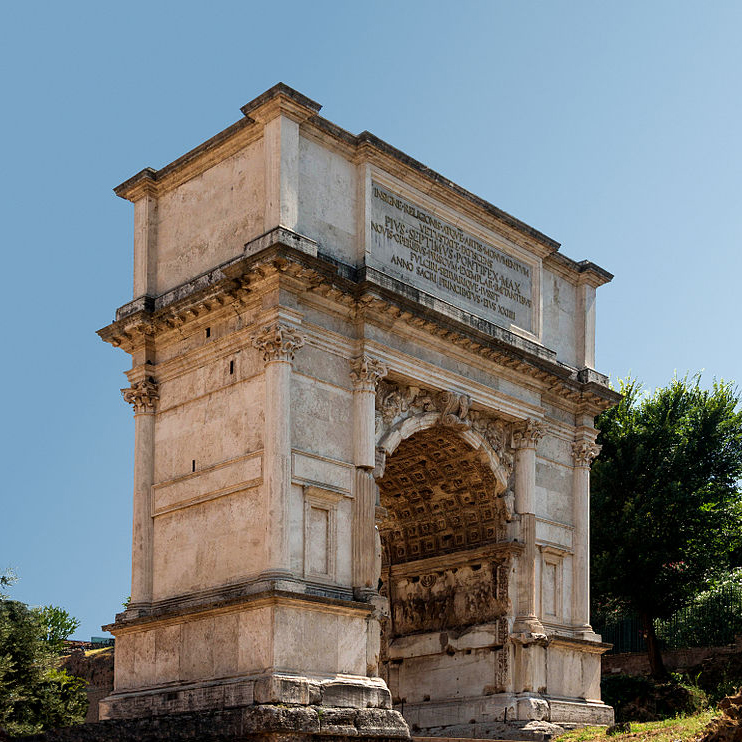
The Arch of Titus was constructed in 82 AD by Titus's brother the Roman Emperor Dominitan. The Arch of Titus has provided the general model for many of the triumphal arches erected since the 16th century—perhaps most famously it is the inspiration for the 1806 Arc de Triomphe in Paris, France, completed in 1836.
(Senatus Populusque Romanus divo Tito divi Vespasiani filio Vespasiano Augusto)
"The Roman Senate and People (dedicate this) to the divine Titus Vespasianus Augustus, son of the divine Vespasian."
(Insigne religionis atque artis, monumentum, vetustate fatiscens: Pius Septimus, Pontifex Maximus, novis operibus priscum exemplar imitantibus fulciri servarique iussit. Anno sacri principatus eius XXIV)
(This) monument, remarkable in terms of both religion and art, had weakened from age:
Pius the Seventh, Supreme Pontiff, by new works on the model of the ancient exemplar ordered it reinforced and preserved.
In the 24th year of his sacred rulership.