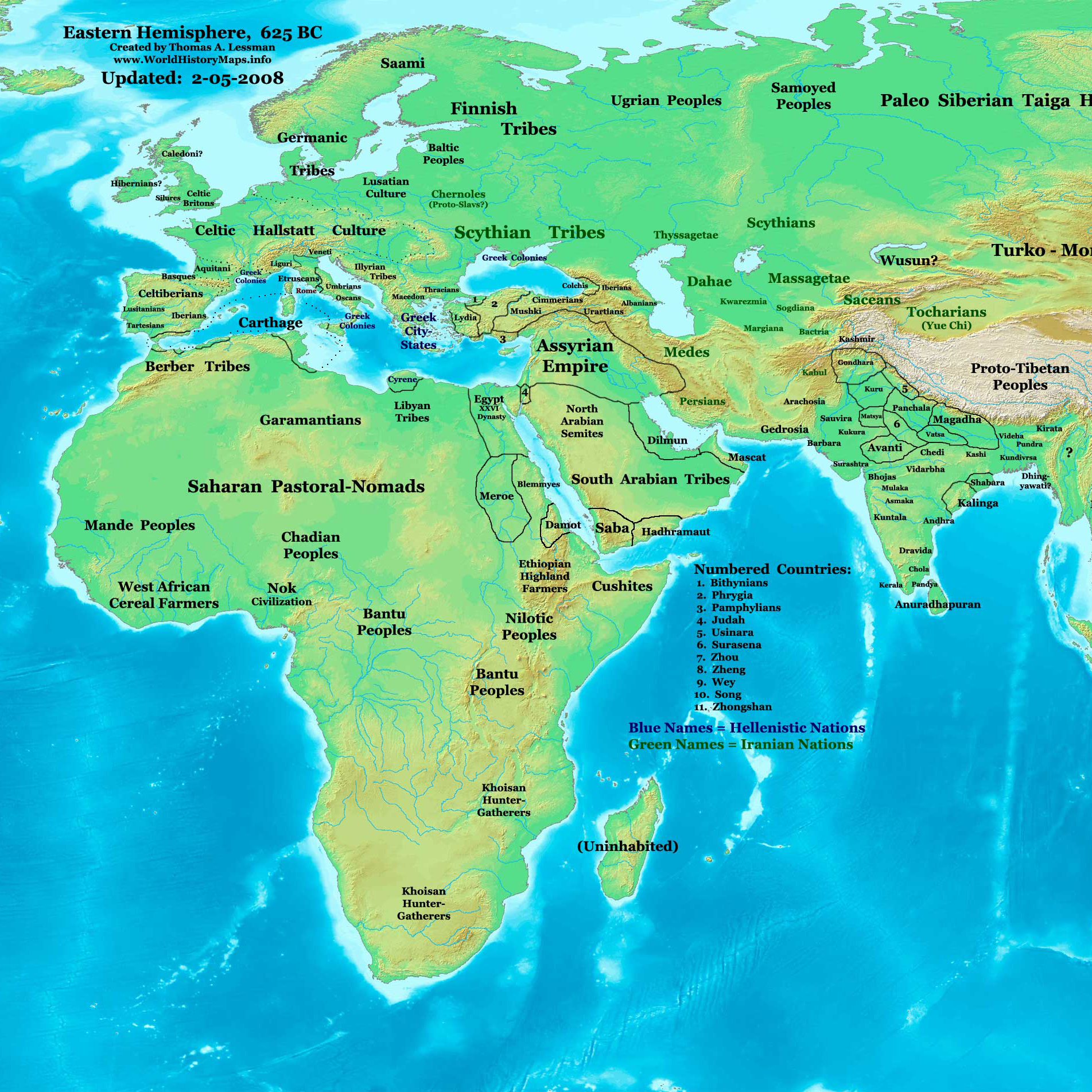
Miletus was an ancient Greek city on the western coast of Anatolia, near the mouth of the Maeander River in ancient Caria. It was the wealthiest city state of its age and had a trade with Egypt and Lydia. However their inheritance is much bigger than this wealth. Miletus was the city that philosophy was born. Thales, Anaximander and Anaximenes were the lead figures of their philosophy and the name of their school was Milesian School.
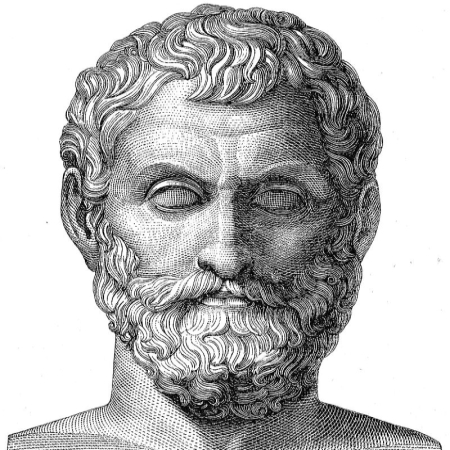
The first figure and one of the Seven Sage Men of Antique Greece was Thales who remembered as the founder of Philosophy though Bertrand Russell describes him as “perhaps rather as a man of science than as a philosopher in the modern sense of the word.” Russell and many other scholars argue that Thales was the first philosopher engaged in scientific thought, empiricism (knowledge comes only or primarily from sensory experience). However, Thales did not leave great and influential theories but method, empiricism. His successors had used his methods and created many revolutionary ideas. Though it seems simple and foolish to argue the nature of matter is water, it was revolutionary theory. Since, it was the first alternative explanation to mythological stories about the origin of universe.
Naturally, date of both birth and death of Thales are controversial. The only record about these is the chronicle of Apollodorus of Athens (Diogenes Laertius) where his death is narrated as heat stroke while watching the 58th Olympic Games (548 – 545 BC) at his 78. So we can assume he lived between 623 – 545 BC.
Thales travelled to Egypt to learn geometry. Though there are two theorems remembered with his name, Bertrand Russell claims that these were probably Egyptian theorems. These theorems are;
The intercept theorem is an important theorem in elementary geometry about the ratios of various line segments that are created if two intersecting lines are intercepted by a pair of parallels. It is equivalent to the theorem about ratios in similar triangles. Thales used this theorem to calculate the height of pyramids, and the lengths that could not be measured.
Thales' theorem states that if A, B and C are points on a circle where the line AC is a diameter of the circle, then the angle ABC is a right angle. (Even this theorem can be theory of Pythagoras).
Thales was a rationalist and materialist. A story that attributed to him strongly proves his looking to universe. His understanding of future was not related to Gods but nature and its laws. According to the story, he looked sky and invested all of his money for the use of all the olive-presses in Chios and Miletus since he thought that there would be a great harvest of olives. And he did it.
May be he could be the founder of first credit rating company for investors if there was a capitalist economic system.