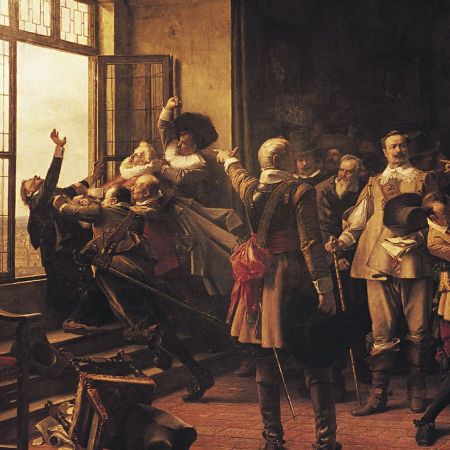
If you ever visited Prague probably you visited the Prague castle which sits on the hill and looks upon Prague. The foundation stone of St. Vitus Cathedral which is the main part of castle was laid on the Hradcany Hill in 1344 at the behest of Charles IV, the future king of Bohemia and Holy Roman emperor. Charles IV start to make Holy Roman Empire great from Prague castle and after almost 300 years in 1618 the bloodiest era of Holy Roman Empire started again in Prague castle. Two Regents of Emperor were defenestrated as it was traditional (in 30 July 1419 the Prague mayor and councillors had been defenestrated at the start of the Hussite insurrection too) in Prague by Bohemian insurgents. It was the answer of Thurn and its allies (protestants) to Emperor Mathias who reduced the area covered by the grant of toleration which was given by previous Emperor Rudolf II by the Bohemian Letter of Majesty.
8 million causality in 30 years without any modern warfare equipment nor mass destructive weapon. Means 8 million people were killed eye to eye by steel, fire and gunpowder. It is easy to understand the hate climate reign over Europe during 1618 to 1648. It was the bloodiest religious war almost every major European powers intervened.
As magnificent Machiavelli compares Turks and Kingdoms like France
“The entire monarchy of the Turk is governed by one lord, the others are his servants; and, dividing his kingdom into sanjaks, he sends there different administrators, and shifts and changes them as he chooses. But the King of France is placed in the midst of an ancient body of lords, acknowledged by their own subjects, and beloved by them; they have their own prerogatives, nor can the king take these away except at his peril.”
It is hard to dominate Turks but if you could than it is easy to rule. On the other side it is easy to intervene and dominate Kingdoms like France by building alliances however it is hard to rule all of them. Holy Roman Empire was the exact sample for this. There were lots of estates many of them identified themselves by their religious choices since nationality and ethnicity were not useful yet. Religious identities played major role for people (elector, prince, archbishop, archduke, king, emperor etc.) who seeks to expand his influence in politics. So alliances rose as religious leagues, catholic league, protestant union etc.. Especially during the reign of Rudolf II, because of Rudolf's lack of intervention to incidents, these conflicts and tensions rose. When the brother of Rudolf II, Matthias elected as an emperor, it was too late to bring all of estates together.
Here are the belligerents of this bloody war and the reasons of their interventions.
CATHOLICS:
Habsburgs/ Holy Roman Empire: There was an Imperial Diet (Reichstag) as a legislative body of Empire. Its members were the Imperial Estates and could be either ecclesiastic or secular. They were grouped in 3 classes, electors who had a right to elect an empire, princes and cities. Since Habsburg dynasty covered the most estates it was usual to elect emperor from Habsburgs. So, Habsburg's identity was important for Empire and it was Catholic like their cousins in Spanish Empire. It is not difficult to guess their reason for that war, they tried to protect their sovereignty.
Allied Estates/ Catholic League: It was a coalition of Catholic states of the Holy Roman Empire formed 10 July 1609. While initially formed as a confederation to act politically to negotiate issues vis-a-vis the Protestant Union (formed 1608), it was subsequently concluded as a military alliance "for the defence of the Catholic religion and peace within the Empire".
Duke of Bavaria, Archbishops-Electors of Mainz, Cologne (Teutonic Knights), Trier, Constance, Augsburg, Passau, Würzburg, Worms, Strassburg, Eichstatt, Speyer, Ellwangen, Kempten
Spanish Empire: It was the most powerful and wealthiest empire in Europe. Though their legendary Spanish Armada sank in front of British Isles and could not oppress the Dutch Revolt they were still major power. However things were not good enough as 50 years ago. They were not a single force in open seas anymore they had rivals like English and Dutch. The other trade line Spanish road which is started from Northern Italy and ended in the Low Countries was under threat of Protestant estates. Furthermore they were allies of Dutch. At last the Emperor of Spain was the protector of Catholic Church and cousin of Holy Roman Emperor.
The Polish – Lithuanian Commonwealth: The Polish-Lithuanian Commonwealth was the largest, and potentially most powerful, of the three contenders for Baltic domination. Like the Empire, the Commonwealth has often been dismissed as ineffective and out of step with the general European trend towards stronger, more centralized states though they had undefeatable army. Sigismund III Vasa was the king and he was catholic. He was once king of Sweden too, however protestant insurgents overthrown him. He had claims over Swedish throne still while Swedish' eyes on his lands.
PROTESTANTS (LUTHERIAN – CALVINIST)
Estates: Though it seems all of them Protestants they had big differences in empire politics. While Calvinists favoured military struggle and rigid differentiation, moderates most of them Lutheran preferred to be in Empire constitution. Though they controlled all the larger principalities other than Austria and Bavaria, the Protestant princes weakened their potential power through frequent dynastic partition. The Reformation stopped the general trend towards accepting primogeniture, prompting Protestant princes to retain or even reintroduce partible inheritance in order to provide equally for their children. Unfortunately this coincided with changes in imperial law that fixed political rights in existing imperial fiefs by 1583. Rulers were no longer able to create additional votes in imperial institutions by partitioning their territories, but now had to decide either to share princely rights among their heirs, or give juniors appanages created from the main territory. The latter route reduced the chances of making an equitable marriage since the junior princes no longer held land associated with constitutional rights.
Bohemia: When Vladislas' only son Louis was killed at the Battle of Mohacs in 1526 ending the Jagiellon dynasty rule in Bohemia, a convention of Bohemian nobles elected his brother-in-law, the Habsburg archduke Ferdinand I of Austria. Even Bohemia Revolt started the war, it was oppressed by Habsburgs and Bohemia passed to Catholics in 1620.
Saxony: The Protestant movement of the 16th century was largely effected under the protection of the Saxon rulers. However they were moderates now and sought to preserve rights that had already been gained by the peace of Augsburg (1555) - Rulers of the 224 German states could choose the religion (Lutheranism or Catholicism) of their realms. Subjects had to follow that decision or emigrate -
The Palatinate: The County Palatine was one of the seven electorates. The Elector Palatine adopted Calvinism in 1550's. The elector of Palatine favoured the aggressive stand against Imperial institutions and tried to establish more homogeneous union. The Protestant Union assembled in 1608 however it did not take long to be Calvinist Union.
Frederick V was the elector of Palatine in 1618 and as a result of Bohemian Revolt he was succeeded as King of Bohemia which lighted the fuse of the Thirty Years' War.
Denmark: Denmark was the most powerful and wealthiest Scandinavian though did not have any valuable resources. Danish nobles were poorer than their German contemporaries however Danish king was one of the wealthiest. Fortunate king had a control on The Sound which was the only passage from North Sea to Baltic and vice versa for large ships. Beside, king had an imperial estate, Holstein which would be controversial land through decades.
The Danish Catholic bishops were imprisoned and Catholic Church lands were confiscated while Lutheranism was rising.
So, both king and nobles sought to enlarge their influences on Imperial Estates and Church.
Sweden: Swedes were the poorest Scandinavians in other words savages of North. Gustavus Adolphus throned as a result of protestant insurgent. He was the founder of Sweden as a European power. His reforms led Sweden to be as considerable power. He is often regarded as one of the greatest military commanders of all time. He died in the Battle of Lützen which was on of the most decisive battles of the Thirty Years' War. It was a Protestant Victory however Gustavus was killed and died in accordance to his militaristic fame.
Sweden was considerable Protestant power with Gustavus and sought to dominate Baltic.
Dutch Republic: In 1568 the Netherlands, led by William I of Orange, revolted against Philip II because of high taxes, persecution of Protestants by the government, and Philip's efforts to modernize and centralize the devolved-medieval government structures of the provinces. Maurice of Nassau cousin of William I of Orange and future prince, led some military reforms. If Gustavus was one of the greatest military commander, Maurice was the master of him.
Maurice had supported the Electorate of Palatine and his cousin Frederick V as a King of Bohemia.
Beside these Protestant allies also estates Brandenburg – Prussia, Brunswick – Lüneberg and Kingdoms France, England and Scotland had intervened.