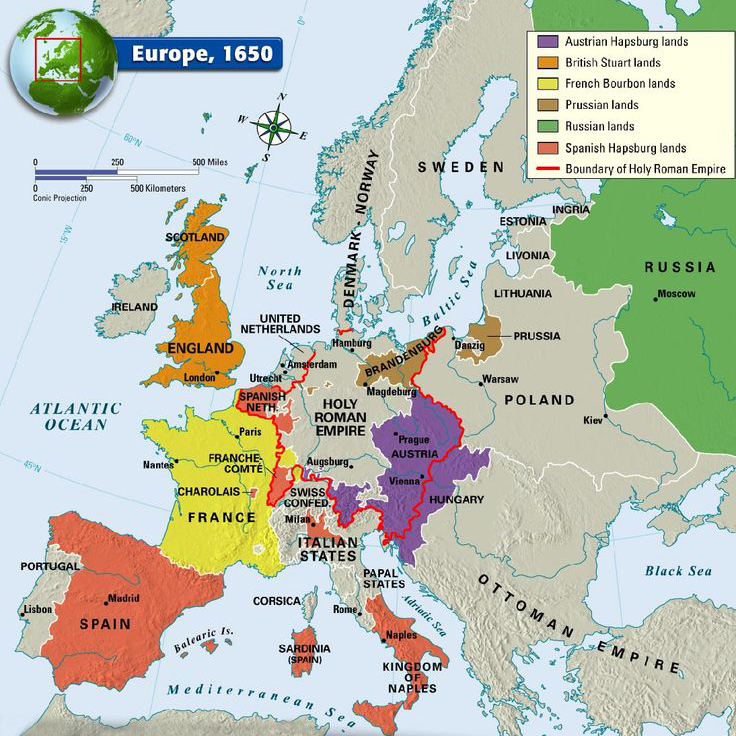
English Civil Wars were complex and detailled civil wars which can not be reasoned by only religion or something else. At the end of Tudor dynasty Stuart monarch was built by Scotland's IV James and England's I. James. He was Scottish and that was a very big advantage for throne cause Scotland had been seen back door of England all time. When son of I. James succeded to throne things began to change.
When we look at mid 17th century's England striking points are, Anglican Church with presbytarian model and puritan movement, rise of commons with merchants. While most of Irish poepla were catholic, Scottish and English peoples were mostly protestan (Puritan – Anglican – Armenian etc.)
Civil War / Revolution Chronology
1633 Charles I had two big faults, one of them was selection of administrators and the other was his stubborn and uncompramising behaviours. His first step of his end was appointment of William Laud as an Arcbishop. Laud was English arminian autocratic man. His first aim was uniform worship in England and Scotland. Although it seems like that aim was in accordance with monarch interests, his methods frightened and provoked many puritans and presbytarians. He restored altars in churches, he forbid worships which are not written in Prayer Book (written by Laud), gave authorities to bishops. 17 years later Mayflower's sailing from England coasts, puritans, separatists and the other protestants were in trouble like never before.
1637 – English feudals had some rights which were gained with Magna Carta at 1215 and the most important right was Monarch could not collect taxes without any aggreement with feudals. However Charles I began to collect money from feudals in the name of ship building programme. It was declared as loan however it was not.
1639 – Scots were more traditional people than Englishs and since they were farther from London their presbytarian system was well. First riots had began in Scotland against Laud's methods.
1640 – Charles I had not a fund for a big army and he could not control Scotland although he was Scottish. His only chance was to call parliament and make and aggreement about fund of army. In 1640 April he called parliaement, however MP's rejected Charles' needs. Their demand was simple. First Charles had to stop his Laudinisian politics and guarantee feudals' property. Charles second wrong choice was Earl of Straffor who was appointed to Ireland in 1633, now he was responsible from parliamanet and as a result of his royalist thinking, Charles dispand short parliament in May 1640.
Scottish rebellions passed England border in 1640's summer and Charles I was again forced to call parliamant. But this time would not be short. Parliament's most influential member John Pym was controlling parliament and their demands are clear. First of all Charles would accept veto authority of Parliament and secondly there would be a standing force which is funded by parliament in London.
1641 – Second uprising had started at Ireland, this time rebellions were catholics. Catholic Irish people saw protestan parliament as a threat. While monarch's power was reducing on the other hand protestan movement was gaining power with parliament and this could be start of some reforms on their churches.
But the main event of 1641 was Grand Remonstrance. It was a list of grievances presented to King Charles I of England by the English Parliament on 1 December 1641. It consists points of objection and calling for the expulsion of all bishops from Parliament, a purge of officials, with Parliament having a right of veto over Crown appointments and an end to sale of land confiscated from Irish rebels. Cromwell commented to Falkland that if the Grand Remonstrance had been defeated, 'I would have sold all I had the next morning and never seen England more; and I know there are many other honest men of the same resolution'
Ofcourse Charles's answer was simple “NO”. And Civil War began.
1642 – First Battle between monarch and parliaments troops
1643 – Civil Was was going on and both parties could not be superior on each other but John Pym's brilliant movement would change the balance in 1643.
Parliament signed and aggreement with Scottish rebellions in the name of Solemn League and Covenant in order to establish presbytarian system and overthrone Charles.
1644 – Two sides of civil war encountered with Marston Moor battle, and Cromwell's cavalaries determined the result of battle. There were 45000 soldiers, like never before or after such a big amount of soldiers stand on English soil.
1645 – Battle of Naseby. Parliamentary New Model Army commanded by Sir Fairfax and Cromwell encountered with Charles' army. Again Cromwell's cavalary was decesive force of battle. It was end of first civil war cause Charles army was defeated and dispanded.
1647 – Parliamant had an aim at the begining of war, and they achieved it but they had not any plan for after it. Since there were several groups in parliament. Independents – Separatists – Levellers – Presbyterians – Sects etc. There were several and different interests and demands. Most of them did not opposit to monarch, but they would like to have controlled and restored monarch.
Independents - advocated local congregational control of religious and church matters, without any wider geographical hierarchy, either ecclesiastical or political.(Separatists – Pilgrims etc. Oliver Cromwell)
Presbyterians - form of church government, which is government by representative assemblies of elders.
Levellers – were a political movement during the English Civil War that emphasised popular sovereignty, extended suffrage, equality before the law, and religious tolerance, all of which were expressed in the manifesto "Agreement of the People"
Diggers – sometimes seen as forerunners to modern anarchism, and also associated with Agrarian socialism, begun by Gerrard Winstanley as True Levellers in 1649, who became known as Diggers, because of their attempts to farm on common land
First of all Scottish army was dispanded by coalition of independents and presbyterians since their battle performance was not good and people who live in Scottish army's landed villages hate them.
Presbyterians next aim was make an aggrement with Charles and reform the England Church, however New Model Army's one colonel secretly capture Charles and brought him into New Model Army's quarter. New Model Army with Cromwell leadership published HEADS of PROPOSAL to Charles.
· The Book of Common Prayer was allowed to be read but not mandatory, and no penalties should be made for not going to church, or attending other acts of worship.
· The sitting Parliament was to set a date for its own termination. Thereafter, biennial Parliaments were to be called, which would sit for a minimum of 120 days and maximum of 240 days. Constituencies were to be reorganized.
· Episcopacy would be retained in church government, but the power of the bishops would be substantially reduced.
· Parliament was to control the appointment of state officials and officers in the army and navy for 10 years.
Charles' answer was again “NO”
1648 – Charles escaped from quarter and began to negotiate with Scottish. He had backwards from English and Scottish presbyterians. Although Presbyterians were more than sum of the other groups at the parliament they could not prevented the Charles' death voting. Because New Model Army colonel Thomas Pride stand in front of the Parliament and led only New Model Army and Independent supporters in Parliament while 270 of 470 presbyterian could not attend. With 57 vote of 80 parliament judged to death of Charles.
1649 – Charles was executed and House of Lords was abolished.
After Charles execution during 10 years there were efforts to provide order, although at the begining of civil war there were not any system without monarch as an aim, first king and then parliament were excluded and Cromwell's dictatorial management established. Cromwell's New Model Army especially as a Navy achieved great successes.