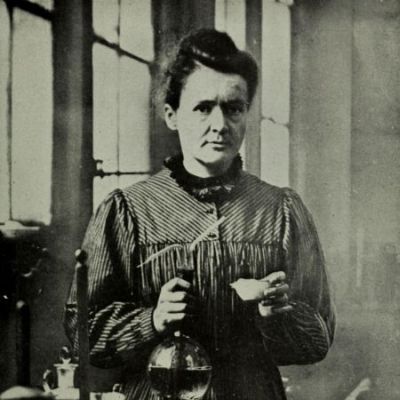
Maria Sklodowska/ Madam Currie was a Poland chemist and physicist, the first woman achieved doctor license in Europe and won the Nobel Prize also the only woman who won Nobel Prize in both Chemist and Physics.
She was born in Warsaw, Poland in 07.November.1867. Her father was a math and physics teacher, mother was a manager in a dorm. She lost one of her sisters and mother before she reached 12.
She would like to study on natural science. However, in Poland under Russian sovereign, it was forbidden to study science for girls. Having sent her elder sister to Paris, Sorbonne, she had moved to Paris. While her sister was studying on medicine, she was participating physics lessons.
They both lived in an attic with almost nothing but ideals. Several times she got ill because of hunger however only ideal she had was to be a teacher and get back to Poland as a teacher. On the other hand she had and was more than this, she finished university with first place and did not stop, and graduation in math would follow.
And now it was the time for doctorate. She would like to study on metals and need a laboratory. She met with 35 years old Pierre Currie who was the physics teacher in high school and he helped her. More than this, they began to study together. In 1895, she married with Pierre Currie.
She began to study on Becquerel radiation with Pierre's suggestion. Radiation of uranium and its effects on ionization of air was found by Becquerel few years ago. However it should be tried to be falsified by several tests.
Curries used an old wooden barrack as a laboratory in the garden of Pierre's school. First she validated the results of Becquerel and argued that the reason of this radiation is uranium atom. Having argued this, she began to try different elements. At last she noticed Thorium element has same radiation effect too. As a result she entitled this radiation, Radioactivity (1898).
While she was trying different elements, she found different, undefined new element. She entitled this element, Polonium (1898).
During all of this time, she and her husband were alone, with insufficient fund and materials, they were working by their hands in their old barrack. Marie was working on mess of uranium element, trying to decontaminate, suspected from different element. It was highly radioactive element, with almost 2000000 times than uranium. However, it seemed impossible to decontaminate this element.
Decontamination needs mass of it, however it was expensive for them to afford. Mr. Currie found a mine in Belgium and they gathered the waste of this mine. It was useless for mine but priceless for Currie's.
At last they succeed in decontamination and called this hidden element Radium (1898).
In 1903, Henri Becquerel, Pierre Currie and Marie Currie shared the Nobel Prize for physics for their work on radioactivity.
Until 1906 she had a lovely marriage with two daughters. Irene and Eve. (Irene would be a successful Chemist in the future and would won Nobel Prize in Chemistry in 1921.). However in 1906 she lost her husband Pierre in a coach accident. Pierre was not only a good husband, he was great partner for Maria in her studies. Nonetheless she never left studying and in 1911 she won Nobel Prize, with her new method for Radium decontamination and for discovering Polonium and Radium elements.
This was the first time in Nobel History that anyone win the Nobel Prize for the second time.
Madam Currie died in 4th July 1934, in her 66, from aplastic anemia (blood cancer). Her studies on radioactivity took her life but her discoveries and inventions led many lives.