A line in the sand which was drawn by a man on a map, without considering culture, tribes, sects etc.
Sir Mark Sykes was an English traveller, attache in Istanbul and parliamentary (the member of conservative party) in UK. He had begun to interest in Turkish and Middle East affairs in 1905 while he was an attache in the British embassy of Istanbul. He travelled to the Middle East several times and took notes about the cities he observed. According to Sykes, Ottoman Empire was on the edge of collapse. It's most beautiful and ancient cities like Aleppo or Damascus were filthy and the society was decaying.
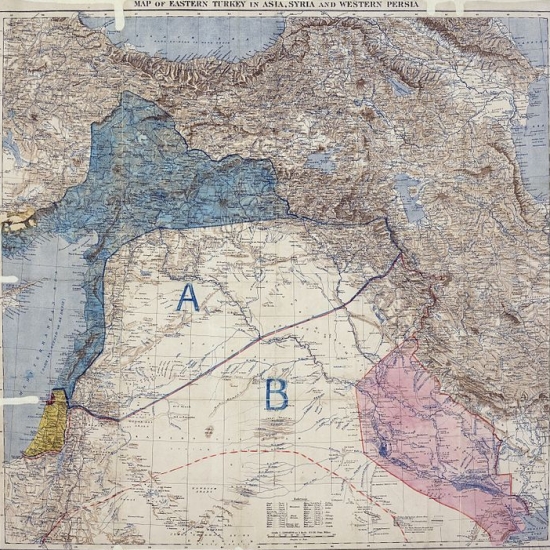
In 1911, he had chosen to parliament as a member of conservative party. He was one of the most intellects parliamentary about Middle East in parliament. Because of this, he was invited to Number 10 (Her Majesty's Government) to present situation and his ideas about Middle East in 16.12.1915. The Prime Minister was H.H. Asquith and the other interesting figures in the 10 Downing Street were Balfour (former conservative prime minister), minister of war Herbert Kitchener and the minister of munitions Lloyd George. Sykes claimed that UK had had to made an agreement about Middle East with France as soon as possible. According to Sykes, Ottoman was going to lose the war and Syria would be the prize of Middle East. His proposal was already drawn; he offered a line from e to k, means From Acre to Kirkuk. As a result of discussions Syke's offer was approved, however this was not enough France should been convinced politically. Especially after the Fashoda Incident and Cordiale Entente. France was ally of UK, however this was an alignment approved under the threat of Germans so it there were still conflict of interests between two rivals.
The major one was Syria. UK had accepted that Syria as an Ottoman Land, where UK could not have any rights or plans without the knowledge of France in 1912. This was the result of Entente Cordial which by UK guaranteed their sovereignty in Egypt. Though, Syria was seen like empty and worthless land for UK in 1912, it had begun to be important. The first need was emerged in 1915. UK had wanted to cut support to Istanbul in 1915, there were two chances to strike one of them was Alexandretta the other was Gallipoli. Even if Alexandretta was the first and easier option this plan was vetoed by France, since Alexandretta was a Land of France and France did not want to let UK go through there with forces, UK and allies had chosen Gallipoli which was ended as a disaster.
Meanwhile in the Arabia, Araps (tribesmen, leader of tribes) were ready to negotiate any opportunity which let them to gain sovereignty on any territory. The first claim was received from Sharif Husein of Mecca, who would like to be a king of all of Syria and Palastine. Of course this was unacceptable for both UK and France however Sir Edward Grey the foreign minister of UK, knew that it would be dangerous to be against Arabs especially if they were going to negotiated with Germans. So, Sir Edward Grey ordered to Henry McMahon who was a British Indian Army officer and diplomat who served as the High Commissioner in Egypt, that UK did one of the best thing they usually can do, they talked with Sharif Husein and did not give any promises while Sharif Husein understood that his offer is accepted.
Meetings began in 23 November 1915 in London. That was like one side meeting cause while UK was being represented by 7 representatives, France was being represented by only single diplomat, George Picot. George Picot was a lawyer, who had worked in Middle East, especially in Lebanon. He tried to arrange a revolt in Lebanon until Ottoman seized the town. So, he was the best option of foreign minister Delcasse with his Middle East experience and knowledge.
In the first meeting, UK read the claim of Sharif Husein whose offer consisted all of Syria as his territory. Of course it could not be acceptable for France, however Picot thought that UK could not be as mad as to prefer Arabs instead of France, and he could not understand the seriousness of this offer.
As a predictable answer, France refused the offer and Picot claimed all of the Syria and Palastine as a Normandy.
The second meeting was in 21 December 1915, this time Mark Sykes was available too. France reduced their claimed territories but did not accept any free Arab state. Arabs were treachery and incompetent people to establish free state, however rising Arab nationalism was a danger and it was not needed to scratch it. The famous line which was drawn by Sykes was presented at that meeting and except Palastine it was accepted. As a result Treaty had been signed in 16.05.1916 by Edward Gray and Paul Cambon. According to Sykes-Picot Aggreement new Middle –East would be like that;
Britain was allocated control of areas roughly comprising the coastal strip between the Mediterranean Sea and River Jordan, Jordan, southern Iraq, and a small area including the ports of Haifa and Acre, to allow access to the Mediterranean. France was allocated control of southeastern Turkey, northern Iraq, Syria and Lebanon.
The only region could not be solved was Palastine. The two men agreed that Palestine would come under international control. This was the great opportunity for Zionism which was powerful especially in England. A cabinet minister, Herbert Samuel, who was both Jewish and a Zionist, spotted the opportunity to promote his long-held ambition to see a Jewish state in Palestine.
Chronology:
2 February 1915 – France refused Alexandretta Plan
25 April 1915 – Battle of Gallipoli was started
August 1915 – Claim of Sharif Husein of Mecca to UK
24 October 1915 – UK's answer to Sharif Husein that UK would recognise most of Sharif claim.
23 November 1915 – The first meeting between France and UK on Middle East
21 December 1915 – The second meeting between France and UK on Middle East
9 January 1916 – Battle of Gallipoli was ended
16 May 1916 – Secret Agreement Sykes-Picot was signed.