Great Fire of Rome had devastated the Rome, there were only three districts completely escaped from fire while four of fourteen was completely destroyed.
Fire's spreading rate was enourmous because of narrrow streets, bad city planning and wooden materials, because of this, its effects were disastrous. But people were more interested in one or someone who had started the fire. While some people blamed Nero, that was not a small number, Nero blamed christians and according to Roman authorities crucifixion was only the price of that sin.
Crucifixions had been started three months after the Great Fire of Rome and there was one fisherman from Galilee, among christians who request to be crucified head downwards. And the name of this fisherman was Simon Peter (Saint Peter) who was one of twelve apostles, ordained by Jesus as the Rock of My Church, considered as a First Pope by catholic church.
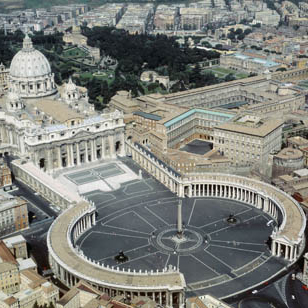
St. Peter's cruxification was taken place near an ancient Egyptian obelisk in the Circus of Nero and his death body was buried into a place where the Basilica of Saint Peter would be later risen. 250 years after St. Peter's cruxification, Roman Emperor Constantine ,first christian emperor, ordered a Basilica which would be placed on the tomb of St. Peter. This Basilica had been the center of Roman Catholic Church from 333 to 1309. In 1309 center of Roman Catholic Church was moved into Avignon France because of the conflict between French crown and Papacy. During Avignon period from 1309 to 1377, old Basilica having been neglected and it was in bad repair. Although first of all Pope Nicholas V started to rebuild and modificate old basilica, his successor Pope Julius II planned far more for St. Peter than Nicholas V. His first aim was demolish old basilica and replaced it with enormous monumental structure where his own tomb which would be designed and adorned by sculpture by Michalengelo, would be rest. A competition was held, and a number of the designs have survived at the Uffizi Gallery. A succession of popes and architects followed in the next 120 years, their combined efforts resulting in the present building in 1626. (Donato Bramante – Raphael – Peruzzi- Antonio da Sangallo the Younger – Michelangelo )
St.Peter's Dome rises to a total height of 136,57 meters and it is the tallest dome in the World. Its internal diameter is 41.47 metres, slightly smaller than two of the three other huge domes that preceded it, those of the Pantheon of Ancient Rome, 43.3 metres, and Florence Cathedral of the Early Renaissance, 44 metres. It has a greater diameter by approximately 9.1 meters than Constantinople's Hagia Sophia church, completed in 537. It was to the domes of the Pantheon and Florence duomo that the architects of St. Peter's looked for solutions as to how to go about building what was conceived, from the outset, as the greatest dome of Christendom. (Selimiye Mosque internal diameter 31,28 meters)
St. Peter's Basilica's construction and its price was like a bottomless pit. One method employed to finance the building of St. Peter's Basilica was the granting of indulgences in return for contributions. A major promoter of this method of fund-raising was Albrecht, Archbishop of Mainz and Magdeburg, who had to clear debts owed to the Roman Curia by contributing to the rebuilding program. To facilitate this, he appointed the German Dominican preacher Johann Tetzel, whose salesmanship provoked a scandal.
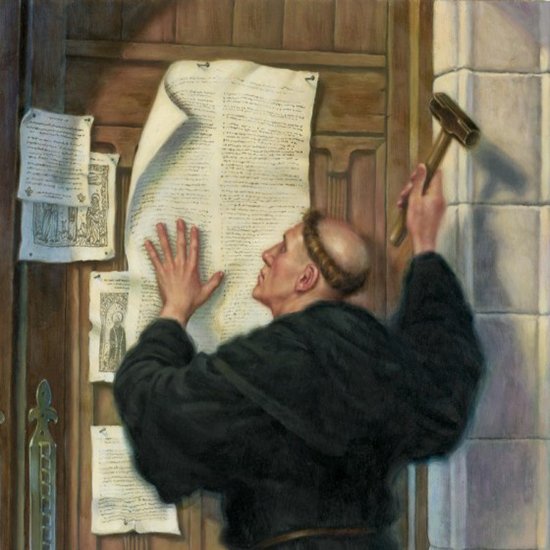
A German Augustinian priest, Martin Luther, wrote to Archbishop Albrecht arguing against this "selling of indulgences". He also included his "Disputation of Martin Luther on the Power and Efficacy of Indulgences", which came to be known as The 95 Theses. This became a factor in starting the Reformation, the birth of Protestantism.
St. Peter's Church is the largest church in the World with its 15.160 meter square interior area and 12 th tallest church with its 136,6 meter height.