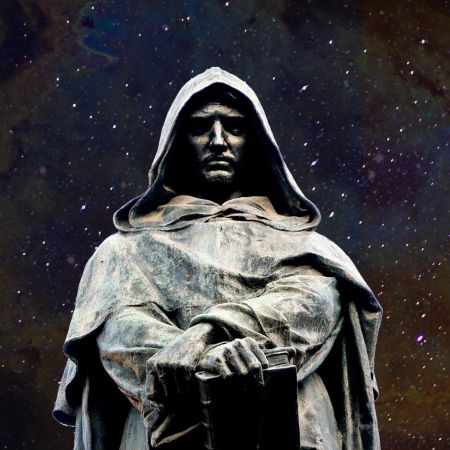
If you ever visit Rome, probably you went to Camp'de Fiori for shopping where beautiful kinds of flowers and fresh fruits you could find. At the center of the market may be you recognized may be not there was a statue of a man, standing as a hooded Assassin Creed fictional character. A man stands among crowded place as he was burnt at a stake 500 years ago at the same square as crowded as today because of his ideas and lack of obedience.
Giordano Bruno, an extraordinary mind, ruthless and stubborn character, unsatisfied soul among people, scholars and aristocrats who did not deserve the position and power they had had already. He was carried on a mule with an iron stick on his tongue through the people and burnt. He was stubborn as refuse to look cross before his execution. To be stubborn and ruthless and have an extraordinary mind sometimes especially in old times could be dangerous.
May be, if he did not have an extraordinary mind he would never notice the recurrence of stupidity of scholars and aristocrats, and if he did not notice the recurrence of stupidity he would never be ruthless to people and he may even be satisfied among them. However he paid his wage of mind by excommunication, by wandering city by city to impress those people who did not deserve the things they have and by fastening to the stick and being burned alive.
The reason of his excommunication was Desiderius Erasmus, another man who noticed the stupidity 50 years ago and wrote a book about it, The Praise of Folly. Bruno was excommunicated since he read the books of Erasmus, his books were on the top of the list of forbidden books. Though he had no idea about wandering the Europe, since he was a child of small town and the world was too small for such a child, he was forced to leave Rome. He travelled to Genova, Venice, Genevre, Lyon, Paris, London, Paris, Wittenberg, Prag, Frankfurt and Venice again. Every city was a new challenge for Bruno, every city has different political situation, religion, culture, language even dialect and precisions. Sometimes he had to be a man who stand with Protestans, sometimes he tried to remove his excommunication. His most important ability may be the one which was could not be denied by anyone, was his memory and method. However his memory was the reason of his trial on inquisition too. Venetian aristocrat Mocenigo who invited Bruno to his house in order to learn memory art, denounced Bruno to Venetian inquisition about Bruno's heretic ideas since he believed that Bruno did not teach him every details of this art and kept something on his own.
Bruno had had several published books with unorthodox ideas and was already excommunicated. Such a denouncement would mean death for him, however according to Roman law, there should be at least two witnesses furthermore Venice's secular authority did not want to execute a man easily because of his ideas. Venice was a cosmopolitan trade city, a passage of many trade goods and ideas, such an execution would affect the popularity of Venice.
On the other hand Bruno, a heretic and potential danger for Church's authority should be carried to the Rome and trailed by the Roman Inquisition. At the end of long negotiations Bruno was transferred from Venice to Rome. However, there was still one more witness required and it was found in Rome; a cell mate of Bruno in Venice.
Bruno's final accusation was summarized by Cardinal Bellarmin in 8 clauses.
1 - The statement of "two real and eternal principles of existence: the soul of the world and the original matter from which beings are derived".
2 - The doctrine of the infinite universe and infinite worlds in conflict with the idea of Creation: "He who denies the infinite effect denies the infinite power".
3 - The idea that every reality resides in the eternal and infinite soul of the world, including the body: "There is no reality that is not accompanied by a spirit and an intelligence".
4 - The argument according to which "there is no transformation in the substance", since the substance is eternal and generates nothing, but transforms.
5 - The idea of terrestrial movement, which according to Bruno, did not oppose the Holy Scriptures, which were popularised for the faithful and did not apply to scientists.
6 - The designation of stars as "messengers and interpreters of the ways of God".
7 - The allocation of a "both sensory and intellectual" soul to earth.
8 - The opposition to the doctrine of St Thomas on the soul, the spiritual reality held captive in the body and not considered as the form of the human body.
A trial which began in 1592 was end in 1600. His last sentence on trial was;
YOU WHO PRONOUNCE MY SENTENCE ARE IN GREATER FEAR THAN I WHO RECEIVE IT.
Probably, he refer the possible pressure and influence on Inquisition from lots of important, powerful and influential people who met with Bruno during his wanderings.
I think, Inquisition did not execute him because of his cosmology but ideas on religion. However he has been considered as a martyr of science now. Though, Vatican is standing behind of the decision of inquisition with declarations in 1942 and 2000. Pope John Paul II made a general apology for “the use of violence that some have committed in the service of truth.”
What was his philosophy? Here is a summary;
“First of all he was not a modern thinker, he was not an observer as Galileo.
He had a great memory. His technique on memory was modelling of every idea. Such a big memory led him thinking and comparing.
He thought that God and nature are one, everything is made of atoms and they can interchange. Everything and everybody are parts of God.
So, God in Jesus body is not a miracle.
A Known world history, 6000 years, is not true. Time is limitless.
If god is omnipotence and omniscience then how Universe has limits. It should be limitless.
There won't be eternal hell, God will forgive.
There are more worlds in universe, however the most ignorant one is ours.”