Although the title of this entry is Izmir Economic Congress, this title describes circumstances and politics of Turkish Republic's economics in between 1923 – 1929. Izmir Economic congress have been chosen since decisions of congress represent the philosophy of period. Even though there were many milestones which determine period's circumstances more than Izmir Economic Congress, like abolishment of Ashar and the foundation of Is Bank.
Izmir Economic Congress was held in Izmir between 17 February – 4 March 1923 during the interval between the two conferences that led to the Lausanne Treaty. It's main purpose to enrich relations which couldn't be built during the War of Independence, between government in Ankara and capitalists in Izmir and in Istanbul. There were delegates from different economic classes in Congress, however they did not actually represents their economic classes. (i.e. Union of Istanbul Ameles). There was actually one class, capitalists and the summary of output was to build and enforce national economic with national capitalists.
Decisions could not be followed because of the Treaty of Lausanne. It was a result of successful negotiations however it could not be expected to erase all of Ottoman Empire's Depts and previous commercial aggreements. Depts were divided between countries who share former Ottoman lands and commercial aggreements were revised. Capitulations were abolished in Lausanne however tariffs (tax on imports and exports) were valid and low tariff on import products had restricted export. ıt was cheaper to import product than manufacture it. So, only the philosophy of Izmir Economic Congress could survive after the signing of the treaty of Lausanne. Support National Economy and Capitalists in Open Market.
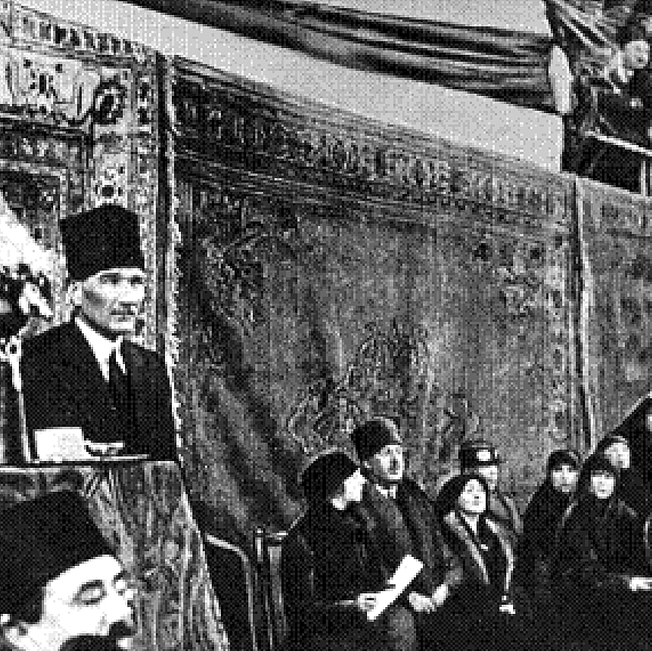
It was impossible to close market to the capitalists who were foreign, anyway the New Turkish Government had never thought it. Mustafa Kemal Atatürk said “We are ready to guarantee foreign capital, in condition to obey our laws.” in the opening speech of Izmir Economic Congress. But how would Turkish Government protect national capital in such circumstances.
It was impossible to change tariff amounts but except in monopoly. If government would get manufacture and import of products and services in monopoly, than government could raise prices in order to raise public income. Think about it, domestic producer manufacture a product for 2$ while it could be exported for 1$. Under these circumstances it is impossible to sell domestic product. However, if government get export of this product in monopoly, he would export it again for 1$ but this time he can raise its price to 2$, and by this way while he is raising income of public income, he gives competation chance to domestic manufacturers.
So, Turkish Government had bought many companies like Reji Company (Tobacco Co. – 4 Million Liras) which had been founded in 1883 by Austrian, German, French and English capital, in this term. But only Railways and Reji company was kept under control of Government, the others were handed over to companies. (i.e. Import of Alcoholic Beverages, Petroleum, Explosives, management of 4 Major Ports).
But who were these companies? They were Aferistler in Turkish. The term Aferist means self-seeking and it was derived from French Affairiste which was similar to French name of Turkish Is Bank, Banque of d'affai-res.
Turkish Is Bank was founded in 1924 as a first National Turkish Bank and it was mandated by Mustafa Kemal Atatürk. Its first General Manager was Celal Bayar who would be the third President of Turkey. It was the highest level of relations between capitalists and government which had been strenghten in Izmir Economy Congress. Is Bank was not a simple bank, there were a lot of former politicians in management and they were still effective in politics. Many economical decisions were decided under pressure of Is Bank and of course the source of this pressure was came from capitalists who had had good relations with these former politicians. Aferists were these politicians and capitalists.They had good relations however not enough capital. At that point foreign capitalists were very suitable for partnership. There were 201 companies which had been established in Turkey between 1920 and 1930 and 66 of them had foreign capital and amount of that capital was equal to % 43 capital of this 201 companies.
However, the most effective and remarkable event of this period was the abolishment of Ashar. Ashar was a tax which had been taken from farmers. It was the main pillar of Ottoman Empire Budget with its % 20 portion. It was collected by mültezims who had %20 rights on collected products.
In 1925 it was abolished. At first look it seems advantageous for farmers, however it would not work like that. Since the amount of products which is equal to mültezims' %20 rights, can not be sold by farmers themselves. Therefore, this amount would rot and it can not return to farmer as money. At that point somebody have to get responsibility of sales of these products. If we think that, mültezims' %20 portion would be bought by companies, farmers would raise their income. But the problem is, if the state can not put another income value instead of Ashar, there would be inflation and rise of farmers income means anything for themselves.
However, government found another income instead of Ashar. Government had raised taxes on kerosene(gaz yağı) and sugar which were used in cities most. By this way citizens who lived in cities, began to carry budget which was traditionally carried by farmers before
Because of that these times are remembered as the Golden Age of Farmers and peasants.
Winners: Farmers and Capitalists (Especially Aferist)
Losers: Urban Workers and Consumers.